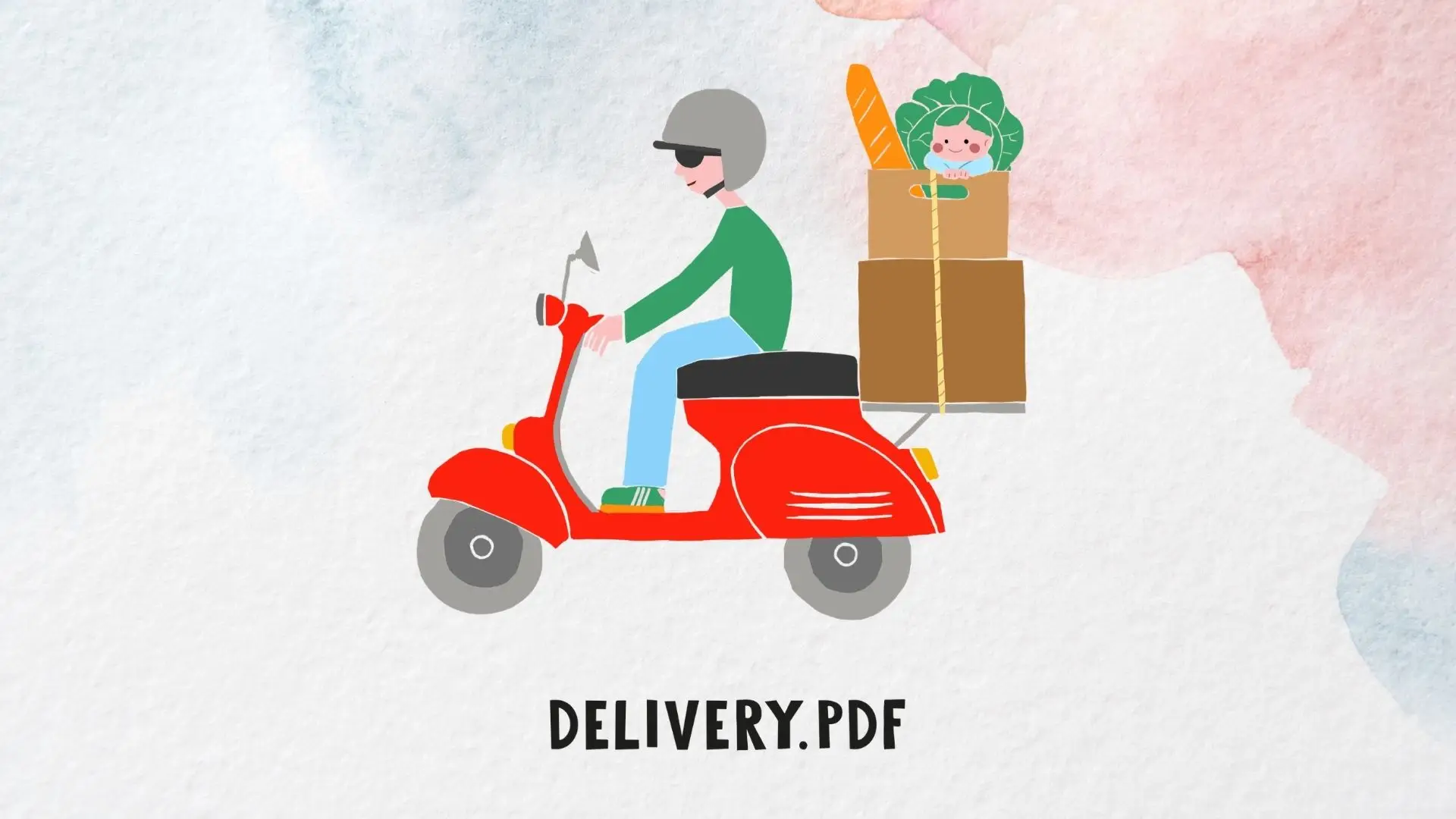
With just a few days to go, Circle emailed us a document entitled 6–Delivery.pdf that inspired me to search for numbers one through five. I vaguely recalled opening them and scrolling past smiling babies alongside obvious advice like “maintain contact with your surrogate.” This time, though, with daddy hormones kicking in, I felt nostalgic and dug up the full set for a proper look:
1–Introduction
2–Matching
3–Contracts & Screening
4–Transferring
5–Pregnancy
6–Delivery, which instructed:
Though you will be busy with your newborn, be sure to visit your surrogate. It is important to give her the opportunity to spend time with you and your baby, and to say goodbye to the baby she has been carrying. Surrogates may want to hold the baby, and we encourage you to allow her to do so to the extent you feel comfortable.
I was pleased that Circle took a stance on what felt like the elephant in the delivery room. Post-birth etiquette had been a cross-that-bridge topic, but Paolo and I were clear on two things: (1) Sara wouldn’t breastfeed, and (2) we wouldn’t deprive her of physical contact with Leila. Within the margins of those two extremes, it was hard to predict the right balance.
We didn’t want to be cruel, but we had to set a different tone going forward. She had stayed at my parents’ house for the embryo transfer; she followed us all on Instagram; we texted constantly. It’s fair to say we didn’t have boundaries during the pregnancy, and I wanted to tactfully signal the importance of a near-future shift in that dynamic. I asked if we should unfollow each other as a way of suggesting we should.
“I don’t think so,” she replied. “It will be harder for me not seeing that she’s doing well with you guys.”
Touché. I didn’t push back and figured, First let’s have the baby, then we’ll cut the cord(s).
We took her out for dinner the night before the induction, and I was struck by how ordinary everything felt on the brink of such an extraordinary event. We walked in—well, Sara more a waddle—sat down, ordered, ate, paid, walked out, and said, “Sleep well!” but knew none of us would. That’s what makes an induction both great and weird: it removes all mystery. I was glad it turned out this way, but it imbued the night before with colossal anticipation. I was texting with a friend who wrote, Oh my goodness! You’re going to pick up Baby tomorrow? Seeing her words in writing, she sent an immediate edit: ‘Pick up’ sounds wrong. I meant: welcome Baby lovingly into the world!
It was a cute redaction but she was right. “Pick up,” while not the most elegant way to frame it, was not untrue.
The hospital had 14 private rooms serving as one-stop shops for labor, delivery, postpartum care, and, in our case, IP accommodation. Only later, after talking with friends who gave birth in crowded wards, did I realize how swanky it was to have a whole room to our non-pregnant selves. Thank you, suburban America.
Most of the nurses had never handled a two Dad + surrogate pregnancy before, so we cut them some slack when they called Sara “Mom.” It first came up when a nurse explained the bracelets.
“There are two of them. Mom gets one and one of you gets the other.”
“I’m not the Mom,” Sara protested. “Can’t they just have both?”
The nurse checked with her manager and confirmed that the woman giving birth must wear a bracelet, so they printed two sets, as they do for twins.
The second misstep was more shocking. While rattling off questions from their standard intake form—“No alcohol during the pregnancy, right? No marijuana? Any biological anomalies such as two cervixes?”—the nurse asked, “This is a private adoption, correct?”
Sara was once again quick to speak up. “It’s not an adoption. I’m not related to the child in any way.”
“Oh, okay, so…” the nurse replied, stalling as she scanned the options in her dropdown menu. “I’ll put surrogate parents. How’s that?”
Fuckin’ accurate is how that is.
From there, the nurse had Sara pump colostrum for Leila’s first feed. At our request, she also prepared a cord blood banking kit. The science around using stem cells from cord blood was nascent, but it felt like a smart hedge in the event those cells could one day cure a disease like leukemia.
At 10 a.m., Dr. Stevens gave Sara an induction medication called Cervidil. The stronger option was a synthetic version of oxytocin called Pitocin, but it made her nauseous.
To Sara’s dismay, at 3:30 p.m., Dr. Stevens concluded that Cervidil wasn’t producing the required dilation to break her water. He switched to Pitocin and tethered her to an IV. A nurse upped the dose every 30 minutes, causing progressive discomfort and a close call with the vomit bag.
Sara went from pregnant friend to hospital patient. As the drug entered her veins in steady measure, I saw her face contort in pain, and I felt guilty for putting her in this position. Rationally, I knew she’d longed to carry someone else’s child from the moment she had her own, but that didn’t make it any easier to watch her suffer for our benefit.
At 9 p.m., Dr. Stevens broke Sara’s water with what she described as the hook part of a hanger.
At 10 p.m., the anesthesiologist gave her an epidural.
From that point on, nurses appeared with increasing frequency to measure Sara’s dilation on a scale up to ten centimeters. When the first nurse strapped on latex gloves to dive in, we took that as our cue to leave the room. After this happened three more times—a nurse entered, we left—Sara said, “You guys can just stay.” So we did, but we made sure to look the other way during the next few checks. By the end, though, they were happening so often that even turning our heads seemed like an overly dramatic reaction, so while we didn’t stare at Sara spreadeagle, we also didn’t pretend that she wasn’t having fingers shoved up her vagina in front of us.
At 11 p.m., she dilated to nine.
At midnight, she hit ten.
During the final pushes, I found myself matching Sara’s breathing, inhaling and exhaling in sync. It was initially an unconscious act of imitation, but once I realized, I exaggerated the sound to convey solidarity: in-out-in-out. Had I been her husband, I would have held her hand or propped up her leg, but I didn’t want to overstep, so I panted loudly from the sidelines.
Dr. Stevens was needed for another birth. He looked Sara in the eyes. “Do it now or I have to tend to that one.”
The competitive pressure worked. Sara’s expression changed to pure grit as she pushed Leila out seconds later. Paolo and I were ready for our first fatherly duties: he cut the umbilical cord; I did the first round of skin-to-skin, also known as “kangaroo care”—body contact to help regulate the baby’s heart rate, breathing, and temperature, to stimulate its digestion, and to create a deep bond with the parent(s), deeper than if the baby were wrapped in a blanket or placed in a crib right away. I’d requested skin-to-skin over cord-cutting because I’m more squeamish. And more vain. (“One of us needs to be shirtless? Fiiine, if I must.”)
My stomach became the landing pad for a slimy ball of flailing limbs coated in blood and sticky white stuff I wish they’d told me about before—a residue called vernix that, this being Wisconsin, they called “cheese.” It was not the sexy photo op I’d envisioned, and far worse than cord-cutting on the bad-for-squeamish-people spectrum, but holding her was a joy unlike any I’d ever known. Her crying finally stopped as her squishy head found solace against my chest. I looked up and saw Paolo leaning down to plant a kiss on my forehead. With Leila in my arms and me in his arms, we formed a trinity. A family.
Out of the corner of my eye, I saw Sara eject the placenta into a bucket of blood as nurses pressed on her stomach to expel additional womb furnishings. (My term, not theirs.) It was gruesome but I couldn’t look away. Like roadkill.
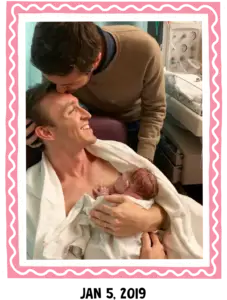
As Paolo and I posed for photos and FaceTimed with family, Sara went from starring role to backdrop. In the flurry of activity, it was easy to lose track of the minutes going by. I was ecstatic holding Leila but also cognizant that Sara might feel hurt if we paraded around for too long. After Paolo had his turn at skin-to-skin, we handed her over.
Sara stared into Leila’s eyes. No matter how much she’d prepared for this moment, the reality of giving birth to a baby she wouldn’t keep was impossible to simulate. I studied her expression for insight into her emotions. Her face was frozen in an enormous smile. Given that she usually talked a mile a minute, the silence became an unnerving aberration that had me wondering, Will this be an ‘Okay, time’s up!’ situation? Say something, Sara. Don’t get weird on us. Say something.
To be fair, it had only been like 15 seconds, but with all the adrenaline coursing through my body, my internal monologue became increasingly histrionic.
Finally, she spoke.
“The feeling is so different from my own boys.
It doesn’t feel like my baby.”
“That’s so interesting,” I said, while thinking, Oh thank God.