
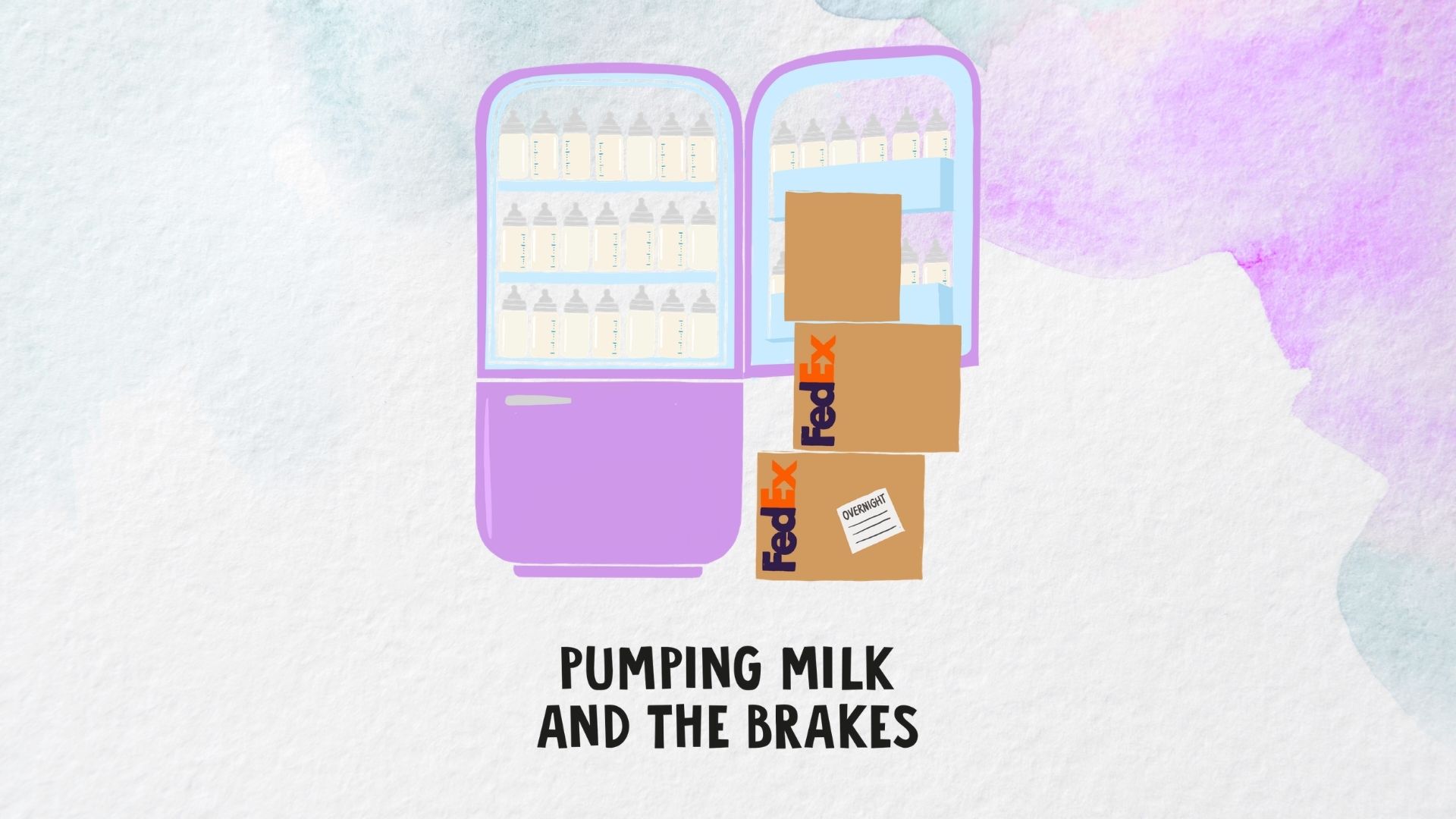
Sara had boasted about her milk supply, and she didn’t disappoint. She was a prolific pumper, producing 60 to 90 ounces a day. To put that in perspective, Leila only drank 16 ounces per day at the start. The plastic pump bags had lines on them for the date and volume, which Sara recorded meticulously, and also a name, where she let loose. On one bag she scribbled Princess, on the next London Gal, Peanut, Hun, and so on—a fun discovery each time, like the jokes on popsicle sticks.
While she endured the hassle of pumping, we endured the absurd cost and logistics of getting milk from Wausau to Los Angeles. FedEx sold a cold shipping box for items that required a temperature-controlled environment. Marketing to “career-minded mothers,” their website said, “The cold shipping package can help you maintain your milk expression schedule throughout your trip.” (They missed a killer pun around Federal Expression.)
The box came with a single-use cooler engine to keep contents between two and eight degrees Celsius for up to 96 hours. It cost $155. Expedited shipping cost around $400. Upon hearing this, one female friend exclaimed, “Jesus, that’s my weekly rent! Pay for my apartment and I’ll give you milk.” She looked down and cupped her breasts. “I’m sure there’s some in there.”
Paolo and I felt that same sticker shock at first, but this was the only convenient and reliable option. Sara simply called FedEx when a box was ready, and they billed our account. We could have gone the DIY route, but she would have had to place Styrofoam containers in cardboard boxes, pad them with dry ice or gel packs, insulate them with newspaper, and seal the boxes tight. It would have been way more effort and still required overnight delivery, plus we wouldn’t have known if the boxes had stayed cold enough in transit. Fluctuating temperatures cause spoilage, and when it’s milk for your newborn, you do cry over it.
Sara filled about six FedEx boxes in one week. I tried to send her enough to stay in sync with her pumping, but they came fully assembled with thick walls, and we didn’t want to crowd her home. Wisconsin in January meant she had a natural freezer outdoors and could leave milk bags in the garage while waiting for boxes.

In L.A., meanwhile, milk took up every inch of freezer space in my parents’ house.
A few weeks in, curiosity and alcohol got the better of me. I came home from dinner with a high school friend and opened the freezer to show off our loot.
“See all this? Breast milk!” I proclaimed with Barnumesque flair.
He asked if I’d tasted it.
“No. But I will if you do.”
High school friends have a way of making you revert to high school maturity levels. I removed a bag. “Sara said it tastes like melted vanilla ice cream. And she did urge me to try it, so…”
We let out giddy giggles as I poured a few drops onto two spoons. We held them up—“Cheers!”—and dipped our tongues in like cats. We looked at each other with the same expression—Not exactly vanilla ice cream—and reflected on whether those previous four seconds were gross or merely peculiar. It didn’t taste bad, per se, but it felt like a violation of some sort. Of her…of us…of the laws of nature. We washed the milk and the thought down with whiskey.
At the end of our one month in L.A., Sara had pumped three months’ worth of milk, equating to 25 FedEx boxes (and, yes, thousands of dollars). Like in old-timey America, someone delivered milk to our door every other day.
We weren’t going to ship more from Wausau to London, and we could only bring two industrial freezer bags on the plane, so we halted production.
Sara wrote that “drying up” was painful.
I thought back to the countless text exchanges where I struggled to come up with the right words. I genuinely felt for her. While breastfeeding her own two boys, she got mastitis, an infection caused by a clogged milk duct. With us, she first tried disposable absorbent pads to soak up leaking milk, but they ripped her breast tissue off, so she switched to reusable ones. And now, after the hard work was over, it hurt to stop.
She mentioned that cabbage leaves and peppermint oil can help. As an Intended Parent, I would have promptly googled best cabbage for breast pain and sent her some. It’s my love language. (Gifting, not cabbage.) But in the transition from IP to P, as a full-blown parent, I had to be careful not to prolong the
surrogacy dynamic.
The end of pumping served as a clean break, a demarcation between surrogate and ex-surrogate. As with any ex, I had to change my behavior accordingly. I had to treat Sara the way I treated every other girl who once had my sperm in her body: amicably unavailable. I never ghosted, that’s awful. I coasted. Minimal effort comms. I didn’t initiate conversation, and I often just double tapped her comments to add a heart instead of writing a proper reply.
To Sara’s credit, we never had reason to fear she’d require a restraining order. Quite the opposite. She stopped texting on her own, and her replies to my Instagram stories were as generic as anyone else’s:
“So cute.”
“I can’t believe how fast she’s growing.”
Years from now, her comments might morph into, “Has Leila asked about me?” or, “Can we FaceTime?”
At which point I’ll consult with Paolo.
And Leila, too.
We’ll balance Leila’s wishes with our own. She may have no interest in learning about Sara, or she might beg us to meet the woman who brought her into this world. Just like how, one day, we’ll sit Leila down to explain the birds and the bees, one day we’ll explain the words and the fees: donor, carrier, and the fact that money changed hands to have her as our daughter. I’m preparing for questions like, “You paid for me? Was I expensive?” with answers that don’t sound like, “You sure were, so finish your broccoli.” No, my real answer will be a sweeter version of what I’d tell someone who questions whether gays should be allowed to do surrogacy: we wanted a kid so badly that we researched the best way to do it and found two amazing women to make it happen.