The next day, Sara came by our room every few hours with freshly pumped colostrum. The amounts were so small and the liquid so viscous that we used a mini syringe to squirt it into Leila’s mouth, like feeding a baby bird.
“All done,” we once said to a nurse.
She peered into the container—“Oh no you’re not!”—and used a gloved finger to scoop up every last milliliter. In a similar act of resourcefulness, another nurse tilted the container over Leila’s mouth and waited for gravity to assist in forming a minuscule globule.
Other lessons we learned from the nurses included: how to change a diaper, how to pick Leila up, how to put her down, how to swaddle, how to soothe, and how to wipe a girl (front to back, for the uninitiated). I wondered if this level of attention was the norm. I suspected not. I suspected that, as helpless men, we were getting special treatment, and I wasn’t complaining.
…with one exception. On our last morning, a woman clutching a clipboard entered the room. She introduced herself as the Care Coordinator—the member of staff that works with people who face a challenging transition after giving birth, like returning to rehab or an assisted living facility. She was under the impression that we’d adopted Leila, and she wanted to ensure we felt comfortable looking after her. Someone in the hospital had flagged us as high-risk parents, evidently, and I was offended by the notion that gays would trigger the same protocol as addicts.
That was my immediate reaction—annoyed.

With the benefit of hindsight (and sleep), I can come up with a more generous reading: the staff wanted what was best for the child, and that wasn’t obvious to them as it was to us. In seeing how qualified we were as new fathers, and by better understanding the drawn-out process we’d gone through to reach that point, they learned a valuable lesson about surrogacy births and would manage them more gracefully in the future.
I’m confident they will, actually, because as we were leaving, the head nurse Maria asked for feedback. The service had been outstanding, I reassured her, and we knew that everyone had the best intentions, but if she wanted to foster a welcoming environment for all types of parents, I encouraged her to brief the team extra thoroughly before an unconventional pregnancy. It doesn’t build trust when a nurse mislabels the birth she’s overseeing. Maria wholeheartedly agreed.
I also suggested a new way to greet people in a situation like ours. “If I were in your position,” I said, “I’d open with something like, ‘What should our team call each of you?’ That would go a long way.”
That night, I received an email from Maria with the subject line The Language of Surrogacy that contained several paragraphs of reflection. Going forward, she’d make sure that nurses weren’t on autopilot when a pregnancy differed from the norm. But at the same time, she admitted that alternatives to “Mom” were hard for her to embrace for a reason that hadn’t crossed my mind. She wrote, “Carrier, surrogate, donor—these words feel cold, and maybe I struggle with them because it’s hard for me to make a birth emotionless.” I was touched by her candor and printed the email to put in Leila’s baby book.
(The baby book I diligently maintained for five days.)
Our final task was to get an Okay to Fly letter from the pediatrician.
“Where’s Mom?” the receptionist asked. “The booking is under Sara.”
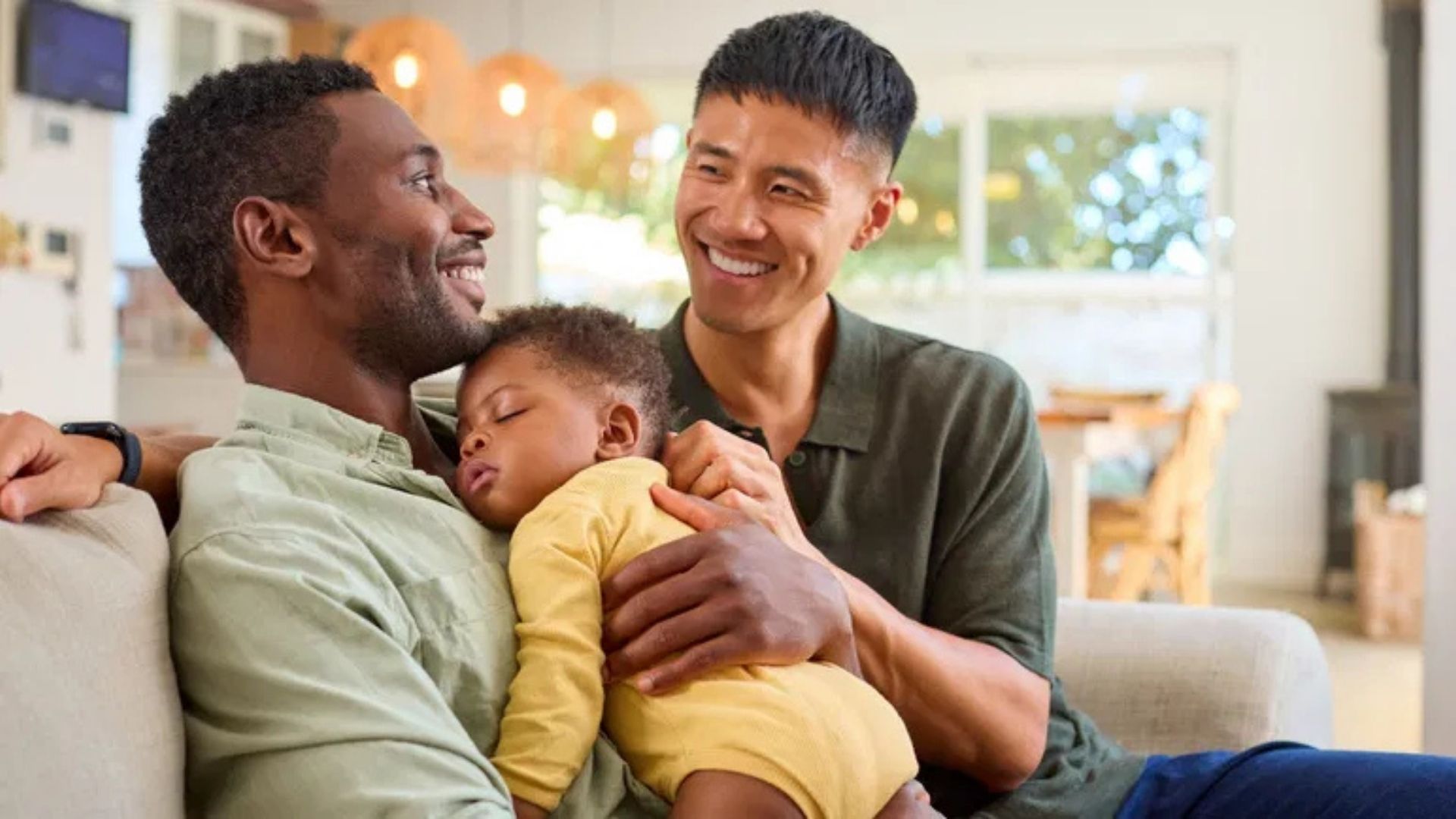
And so it begins, Paolo and I thought to ourselves. But far from blaming this woman for the innocent question, we welcomed the immediate taste of confrontation we knew we’d face as gay parents. Better get used to it. We showed evidence of our parentage, and all was fine.
We stopped by Sara’s house to pick up breast milk for the trip to L.A. and to say goodbye. We wouldn’t see each other for many years, if ever, though we didn’t acknowledge that in such explicit terms.
People later asked, “How was the surrogate after the birth?”
“She couldn’t have been better,” I’d reply. But I should have said, “She couldn’t have appeared better.”
Sara looked serene in our presence, but who knows how she felt under the surface. At the very start of the pregnancy, her mom made the unhelpful observation, “You’ve only had boys, Sara. How will you feel giving up a girl?” Sara had laughed while relaying the comment to us, but it haunted me all the way through. It was true, after all, and that fact might have made any standard postpartum emotions even more difficult.
Plus, in addition to parting with Leila, she was parting with us. At the risk of tooting our own horn, our departure likely caused some withdrawal. Weeks earlier, when texting about our post-birth travel plans, we told Sara we’d fly home as soon as possible, probably three days after.
She wrote back, Dang this just got real.
Then a few minutes later: Gah I don’t know why this hit me so hard ha. Makes me sad to think of you all leaving so quickly though I don’t blame you one bit.
For a full year, we had talked every day. For a full year, Paolo and I had provided her with nothing but gratitude, compassion, and a sense of purpose around something truly life-changing. She’d given us a child; we’d given her the nourishing sensation of absolute devotion. Our need was now met. Was hers?
I’d written a thank you note, partly as a memento for Sara and partly because I knew I couldn’t verbalize the same appreciation without breaking down. Which proved true. I was one strong blink away from tears the whole time we were in her house, but she and Paolo managed to keep it together, so I did, too.
It was a beautiful scene: Sara settled back at home, her two boys fawning over Leila. “This was the baby in Mommy’s tummy,” she explained to 5-year-old Max and 3-year-old Josh as they knelt beside the car seat to look at Leila’s sleeping face. It was the perfect parting visual.
Boarding the plane, I got a confirmation email from the cord blood banking company. They’d received our collection kit and were storing 720 million stem cells in a liquid nitrogen tank at negative 196 degrees Celsius. I marveled at the quantity of cells and smiled at the idea that freezers bookended our journey, housing all of Leila at the start and a piece of her at the end.