
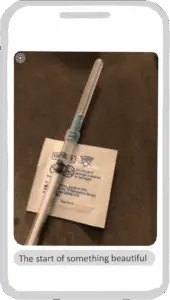
While Little Miss Straw 1 waited on ice, Dr. Sahakian sent Sara prenatal vitamins, estrogen hormones, and steroids to trick her body into thinking it was already pregnant. It was a hefty bundle with one month’s worth of needles and syringes—a care package that could have been a scare package, but Sara worked as a dental nurse and wasn’t intimidated. She sent us this text when it arrived:
The embryo transfer typically occurs 19 to 21 days from the start of medication, at which point an ultrasound confirms that the surrogate’s endometrial lining is thick enough and that there are no ovarian cysts. I’m always careful to say embryo transfer after a friend heard me just say “transfer” and thought I meant the surrogate handing over the baby in some official ceremony a la Rafiki holding up Simba on Pride Rock.
When surrogates need to travel out of state for the transfer, they often bring a companion, but Fabio and Sara’s mom had to stay with their boys, her dad was working, and it was short notice to find a friend who could take time off midweek. She texted, If my friend can’t come would it be ok to stay with your parents? As a backup plan? If that’s too weird let me know!
My mom and dad were touched to be involved, so this backup plan became the upfront plan. Sara would stay in my old room, the default guestroom in my parents’ house. Little did I know 12 years earlier, while losing my virginity to my high school girlfriend in that bed, that a married mother of two would one day sleep in it prior to carrying a child for my husband and me.
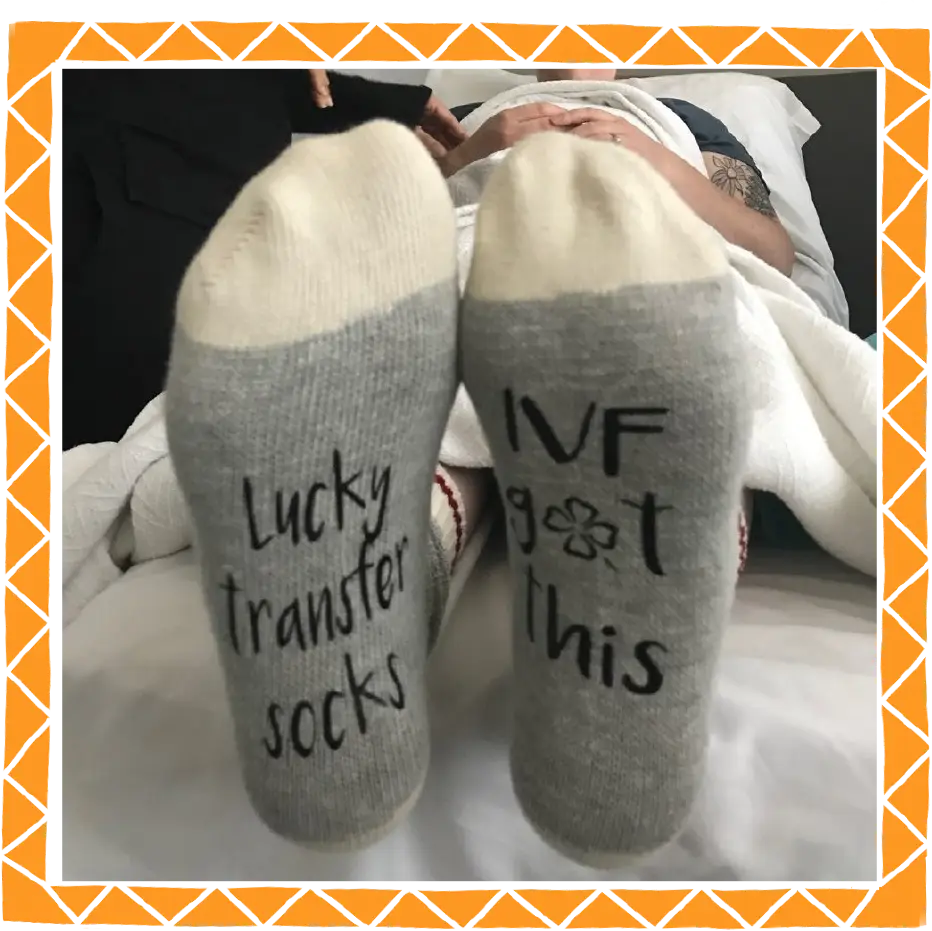
Sara had mentioned that some surrogates wear special transfer-themed clothing. Upon hearing this, I spent way too many minutes on Etsy browsing shirts with slogans like Sticky Vibes, Putting Their Peas in My Pod, and I’m the Stork. Those were all tempting, but I ultimately went with something more discreet:
Sara also told us about two other transfer-related customs that she’d read about on Facebook: eating pineapple cores and doing acupuncture.
I was half skeptical, half intrigued, and fully in favor of anything to help the cause, so we booked acupuncture treatments for before and after the transfer. The woman’s name was Nefertiti, which made the whole thing feel even more like a Seinfeld episode: “Nefertiti, Queen of Needles, will now perform the ancient fertility ritual of stabbing your surrogate’s vagina.” That last part is of course a joke. (Well, not of course—I confess that I wasn’t sure where the needles would go, but it wasn’t down there, I learned.)
The actual transfer took less than three minutes. I know this because my mom filmed it, resulting in one of our more unique home videos. It went as follows:
- Dr. Sahakian applied cold jelly to Sara’s lower abdomen to facilitate the ultrasound, visible on a screen next to him.
- He washed her cervix with water, and asked her to state her name and the name of the genetic father.
- The embryologist, wearing a hairnet, surgical mask, and gloves, handed him a long thin tube and said, “One female embryo.”
- With his other hand, Dr. Sahakian grabbed an equally long and thin instrument to guide the tube into Sara’s uterus.
- As the tube entered her body, the black ultrasound screen lit up with the tiny white dot of an embryo.
- Dr. Sahakian said, “Transferred” as he pulled the tube out, causing the screen to go black again.
“Don’t move,” he said, followed by, “It went very well. You did great.”
Sara then had to stay on her back for 45 minutes in desperate need of a pee. A full bladder makes the ultrasound easier to read, so I get that part, but I’m less clear on the reason for sustained immobility afterwards, as it seems unlikely that standing up or peeing would cause the embryo to slide out like a marble. But what do I know?
Nefertiti had been quietly observing in the corner. She emailed us to say that Sara “was in a beautiful state of relaxation” and that Paolo and I had chosen “the perfect vessel.” She gave Sara post-transfer recommendations that did in fact include pineapple cores, giving credence to the Facebook chatter around their nutritious fiber. Her sign-off was “All things beautiful,” followed by a Chinese proverb. My usual “Best regards” seemed inadequate in comparison, so I tried out “Namaste” and likely offended her.
What Mom’s video didn’t capture was her own reaction. Entering the clinic that morning, she didn’t know the embryo’s sex or genetic father, though I’m sure I mentioned both things multiple times. (Moms, am I right?) While filming, she found out it was a girl with my DNA, and started tearing up. I never intended for such a theatrical reveal but find the image very touching.
Sara couldn’t do anything active for 48 hours.
As if that wasn’t bad enough, she had to expand her daily dose of meds to include vaginal capsules for 11 days.
And if that wasn’t bad enough, my parents subjected her to a screening of my bar mitzvah montage video during her captivity. She said she enjoyed it. I said Stockholm Syndrome.
The next day—just one day after the transfer—Sara sent screenshots from a pregnancy app that showed we were at Week 4, Day 2. I knew that the fertilized embryo gave us a head start, but I expected days, not weeks. I didn’t realize the clock starts on the first day of a woman’s menstrual cycle and that a full pregnancy lasts 40 weeks. Nine months is the typical duration following a positive test.
I feel pregnant, she texted.
Paolo and I laughed. Placebo effect! I texted back.
Sara was firm. Seriously, I have the same dizziness and chest pain I had with the boys. I must be.
There was nothing stopping her from doing an at-home test, but the clinic had asked that she wait ten days for blood work at her local hospital that would yield a more accurate result using her hCG level, the “pregnancy hormone.”
She texted a picture from the maternity aisle of a pharmacy with the caption, Tempted ha. But I’ll wait if you want me to.
We urged patience to avoid a false positive/negative.
Plus, her scheduled check-up happened to fall on Paolo’s 30th birthday.
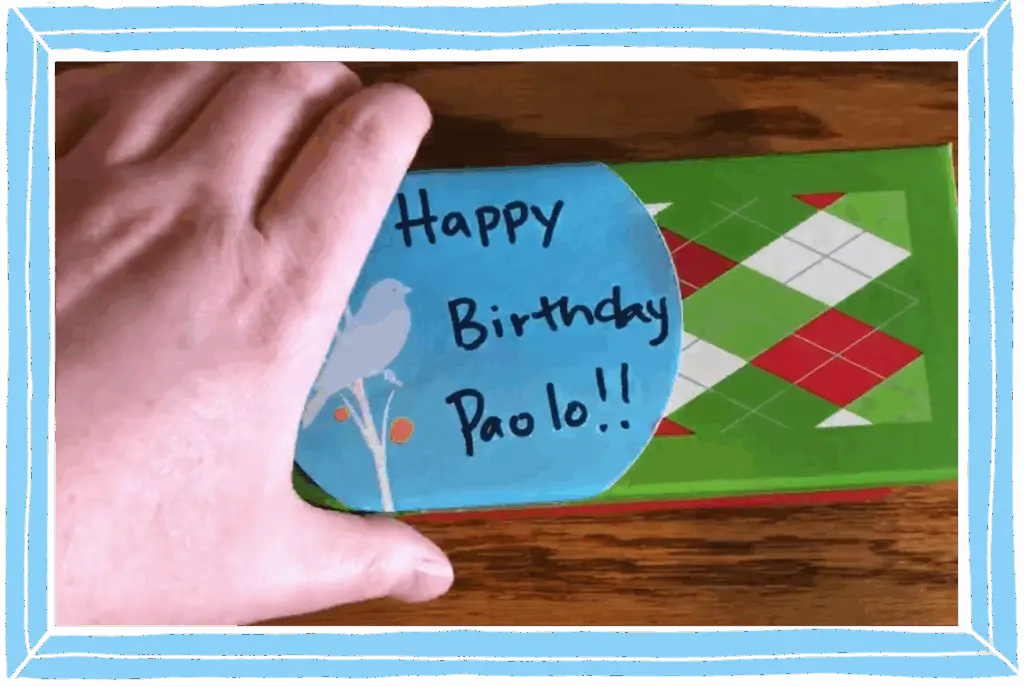
We had planned a short trip to Scotland and were out to dinner when our phones chimed in unison. I slid around our crescent-shaped booth to get shoulder-to-shoulder with Paolo and open Sara’s text together. It was a video of a small box shot from above that had “Happy Birthday Paolo!!” on it. A hand entered the frame to lift the lid and reveal a pregnancy test. The camera slowly zoomed in until the word PREGNANT came into focus. We let out gleeful cries and kissed.
“We’re having a wee lassie!” I said in my best (worst) Scottish accent.
Dr. Sahakian’s 83% success rate had made us confident in this outcome, but anecdotally, among friends who had done IVF, failed transfers seemed far more common. So we’d been nervous. Not a sleepless nights kind of nerves, more an I-can’t-wait-for-this-day-to-come mix of nerves and impatience. Sara had received her hCG results earlier that day and then did the at-home test as a gimmick. The rest of the night and all that week we replayed the video, and felt the same burst of happiness as if watching for the first time.
We also forwarded it to family and friends, which leads me to the topic of sharing.
In one of many calls with Circle, our coordinator asked about our support network. I boasted that it was robust, thinking that’s what she wanted to hear. She replied dryly, “Yeah, you’ll want to shrink it,” and went on to explain the correlation between the size of one’s inner circle and the potential for protracted pain: every person we rejoiced with over good news could deepen our disappointment if something went wrong. Share sparingly, our coordinator advised, to shield yourself from suffering.
We understood the logic but ignored it. Paolo and I are innately open people. We preferred to have friends along for the ride rather than isolate ourselves out of fear that the ride wouldn’t go smoothly.
It’s different with your run-of-the-mill hetero pregnancy where husband and wife have less to talk about. They might use the charming phrase, “We’ve started trying,” but most couples wait until three months to say anything.
With surrogacy, in place of one go/no-go moment, there are several opportunities to toast forward movement: passing the sperm test, selecting an agency, selecting a clinic, matching with a donor, matching with a carrier, the donor passing her medical screening, the carrier passing her medical screening, the egg retrieval, the fertilized embryo report, the transfer, and then, at last, a confirmed pregnancy. To not discuss these milestones would mean suppressing activity spanning many months or years.
A few days after the positive test, Sara said she felt more pregnant than when she had her own two boys.
Maybe cause it’s a girl, she texted. Or maybe the embryo split…
The idea caused mild panic. Our first child was genetically mine; the second would be Paolo’s. A curveball pair of twins would have thrown us off balance. For the next few days, Paolo and I turned to each other out of the blue to say, apprehensively, “What if it’s twins??” To which the other person shrugged and responded, “Then it’s twins!”
Luckily, it was only one week later that Sara went to her local hospital for an ultrasound that confirmed she was carrying a single embryo.
Unluckily, that was the only good thing about this ultrasound. When the baby is bigger, doctors do a standard over-the-skin ultrasound, but early on they use a transvaginal one that is far less pleasant, from what Sara described.
Worse than that, though: the nurse couldn’t find the baby. Sara once miscarried at ten weeks, so she braced for bad news when nothing appeared. The nurse tried again and this time saw it right away; the sac had been tucked into a corner high up in her uterus.
The embryo was the right size but had a heart rate of 94 BPM whereas Dr. Sahakian wanted it over 100 at this stage. He asked Sara to schedule another appointment the following week “to confirm the heart rate is good.”
Needless to say, those weren’t the most comforting words to read.
Sara was restless.
She texted, If it’s still under 100 will he suggest stopping it?
No way! we replied, as if we knew the answer.
The second ultrasound confirmed everything was on track. The embryo had a heart rate of 131 BPM, and tripled in size in just one week. According to Sara’s app, it had grown from a pomegranate seed to a blueberry—a useful benchmark but one that complicated my enjoyment of breakfast staples. How could I possibly eat blueberries when my baby was the size of one?!
I would have preferred the fetus-as-animal system: bee, frog, guinea pig. Or a tech version: she’s as big as an AirPod…now a GoPro…an Echo Dot…ending with a Nespresso machine, a fitting conclusion for soon-to-be exhausted parents.