If finding an egg donor works like Tinder, finding a carrier works like an arranged marriage.
Donor: swipe, swipe, Skype, select.
Carrier: put your best foot forward and trust a third party.
The relative scarcity in surrogate supply, along with their extended involvement, changes the power dynamic. Unlike the open-book market for egg donors, Circle keeps its carriers secret. They present one woman at a time to IPs after that person has already agreed to move forward with the specific couple or individual. The carriers, not the IPs, have the first say.
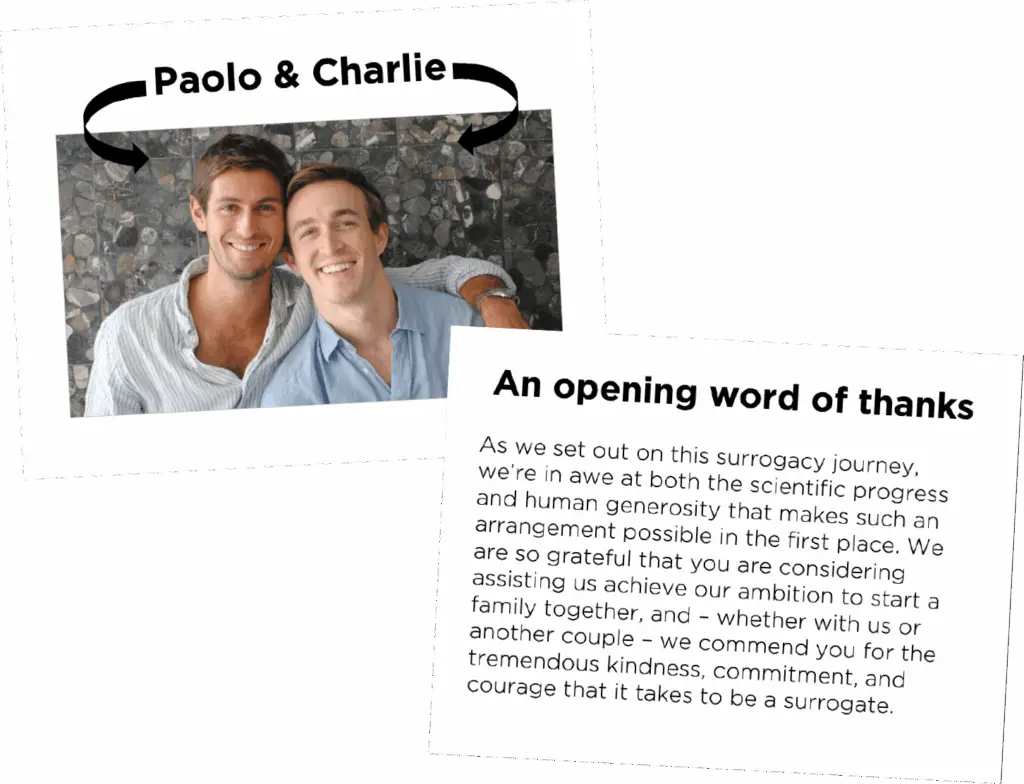
Accordingly, Circle had us prepare an overview of who we were and the kind of parents we intended to be. They shared a list of suggested topics—hobbies, how we met, what our neighborhood was like—and gave us free rein with format. Paolo vetoed my idea to copy Elle Woods’ Harvard application video in Legally Blonde—“Oh, hi!” we’d say from the hot tub as if the camera had startled us—so we made an 18-slide PowerPoint instead. Here are the first two:
We also gave Circle a few parameters. They did the groundwork to filter out carriers who, for example, hated homosexuals, but it was our job to prioritize what we valued. Take diet. Some IPs ask their carrier to eat only organic food, a move that seemed extreme and unnecessarily snooty. We sought to be necessarily snooty. We emphasized nutrition as a core concern, so we needed someone who shared our basic principles: fruit and veg—good; processed food and sugar—in moderation. If that standard was hard to meet for financial reasons, we were happy to throw in a stipend for fresh produce each month.
In mid-December 2017, we received our first match. The email had several attachments and asked for feedback within 24 hours. There aren’t many fish in the surroga-sea, so the more carriers that Circle has in limbo—reserved but not claimed—the slower the process for other IPs in the queue.
One of the attachments was a 10-page report written by a social worker. The headings were: Childhood, Education, Employment, Relationships, Family Life, Medical Health, Mental Health, Legal History, Financial History, Commitment, Support, Surrogacy Expectations, Matching, and Compensation. The conclusion contained the social worker’s overall clinical impression and verdict, which, for any report we’d receive, was a positive one: “This woman is a suitable carrier.” There was a report for her husband as well.
The interview to produce this document left no stone unturned. I felt complicit in a cross-examination as I read sentences like:
“Jess denies any history of STD diagnosis to date.”
“Jess denies any history of infidelity.”
“Jess is not currently religiously affiliated and denies any cultural beliefs that conflict with the idea of surrogacy.”
“Jess received a tattoo a few months ago and understands she may be asked for a letter of sterility from the IVF clinic. She agrees not to receive any more tattoos or piercings until the completion of the surrogacy journey.”
“Jess reports that she got a ticket for underage drinking in 2000. She states she was drinking beer with friends in a park.”
And so on, jumping from bankruptcy to depression to other private information you don’t normally learn about a complete stranger. It also captured her stance on surrogacy-related decisions such as termination, having IPs present in the delivery room, and contact after birth.
Jess seemed like a strong candidate, but the fact that we had no point of reference made it hard to be unconditionally excited.
Paolo and I wondered, Relatively speaking, is Jess outstanding or only okay? Can we do better?
That might sound crude, but this person’s life choices would affect the health of our child.
Then again, we thought, beggars can’t be choosers, and if we reject Jess to then match with a worse candidate, we’ll be kicking ourselves.
Then again (again), our parents didn’t know half of what parents today know about proper pregnant behavior, so does any of this even matter?
We were especially hung up on breast milk. Jess did not breastfeed her own three children and would not pump for IPs. It’s not the most pleasant activity, I’m aware. When I typed pumping breast milk into Google, the top autofill suggestions were nipple soreness and nipple bruising. Then there’s the hassle of fiddling with a machine, finding the right attachment size, adjusting the suction speed, and carving out time throughout the day. Not to mention the potential identity crisis around being a lactating cyborg for a baby you won’t see drink your hard-
earned milk.
So I get why a carrier wouldn’t be pumped to pump, but we’d heard that breast milk (especially colostrum) can aid newborn development, so we sought Dr. Sahakian’s opinion. He replied, “The pumping issue is a personal one and you need to decide how important it is. The vast majority of surrogates will refuse to produce milk.”
That insight complicated our decision. If true, it could have taken months to match with a pumper. But Paolo and I felt strongly. We wanted the breast for our children.
We asked Circle to explore the topic further with Jess. And while you’re at it, we told them, can you politely probe into her eating habits? Is she receptive to general guidelines like avoiding fast food?
On the milk front, Circle reported that Jess “did not like the feeling of the milk filling in; she found this to be painful and uncomfortable.” As consolation, they told us we could use a milk bank, which was an entertaining discovery. It makes perfect sense—no different from other in-demand bodily fluids—but I didn’t know such a thing existed, and pictured assembly lines of busty women in Little House on the Prairie outfits filling glass bottles for dispatch.
On the nutrition front, Jess defended her diet and feared that, based on our probing, we might not be the right fit. In the conclusion of the aforementioned report, Circle’s social worker had written, “It would be best to match Jess with Intended Parents who are laidback like she and her husband are.” I suppose this should have been a red flag. I wouldn’t say we’re neurotic (RIGHT?! SAY IT! SAY WE’RE NOT!!), but laidback isn’t the first word that comes to mind.
With Christmas around the corner, Circle told us not to expect a second match for a while. I was bummed and second-guessed our decision to pass on Jess. Had we shot ourselves in the foot by being too picky?
A week later, Circle surprised us with a second match email. The first-time surrogate in Wisconsin hadn’t even completed her application before they arranged an evaluation—that’s how confident they were in our compatibility. Paolo read the email before I did and ran into the kitchen shouting, “We have the perfect match!”
Circle wrote:
We spoke to Sara about maintaining a well-balanced diet high in vegetables and fruits with minimal meat, processed foods, and artificial sweeteners. She said she does maintain this type of diet and will be even more vigilant during the journey. I also spoke to her about your strong desire for breast milk and she is a big advocate for breast milk so she is really excited that you want her to provide this.
We Skyped with Sara and her husband Fabio four days later, on Christmas Eve. Paolo and I included the disclaimer that we couldn’t get Wi-Fi where we were, so please forgive the poor connection via hotspot. They included the disclaimer that their two sons, Max (4) and Josh (2), were eager to say hello, so please forgive the interruption. Every few minutes, one of them jumped into view to show off their Christmas pajamas and Thomas the Tank toys. It was adorable. And informative—we got a glimpse of Sara’s parenting style, a valuable data point on how she’d be as our carrier.
The call felt less like an interview and more like a kickoff. We emailed Circle with four thumbs up. Sara did the same.
As with the donor contract, this one shared the same central clause about parental rights. Beyond that, it addressed way more possible scenarios, from Sara wearing hospital tags with our names on them to the maximum number of embryo transfers she would allow before calling it quits. The 39 pages answered questions like:
What if the clinic implants the wrong embryo?
What if Sara becomes pregnant with her own child?
What if she ghosts us?
What if the baby has congenital abnormalities?
What if the Intended Parents pass away?
What if the carrier needs life support?
Who covers funeral expenses if the child is born alive but dies immediately after?
Really cheery stuff. But nothing contentious, thankfully, and nothing unique to our situation. We weren’t the first couple to navigate these morbid waters, and I don’t recall disputing any of her lawyer’s recommended language.
Circle connected us with Sara over email, and we migrated to a group chat. The three of us texted nonstop, occasionally discussing the process but mostly just getting to know each other. She wrote messages like:
The boys got a new tea set from Santa and want you to teach them British accents haha.
Do you know your Myers-Briggs type? I did it at work the other day. Just curious!
I added London to my weather app.
We eventually set up a weekly FaceTime routine, but in those early days it was fun having spontaneous text convos that ended with awkward goodbyes like, well, I should probably get some sleep. talk soon!
We were well into the honeymoon phase, but one hurdle remained. Although Circle had reviewed Sara’s medical history, only Dr. Sahakian could sign off on her current physical condition. It’s rare for someone to be disqualified by their IVF doctor, but it does happen, as Sara discovered in Circle’s Facebook group for surrogates. In the days leading up to her medical screening, she learned from Facebook peers that clinics require a certain uterine thickness. One woman had posted in distress after failing this test, something about prior use of an IUD thinning her uterine wall. Sara had never used an IUD, but she was still anxious. Comforting her with the text I’m sure your uterus is thick enough fell into the ever-growing category of LOL moments that seemed perfectly normal at the time.
We flew Sara and Fabio to L.A. for the medical screening, and we flew ourselves there, too, so we could all meet. Initially, I thought it would be nice to host them for dinner at my parents’ house, but then I feared that might result in too much confined intimacy, so I proposed sushi instead. Sara loved sushi and would forego it for nine months, thanks to us, so that seemed like a fitting choice.
Uterine width aside, she was nervous for other reasons before the trip.
On a superficial level—literally—she worried about my parents’ reaction to her tattoo, a half-sleeve flower design on one arm. As it turns out, my mom despises tattoos, but I kept that to myself when Sara asked if she should cover them up. “Don’t be silly!” I lied. “They live in L.A. They’re cool parents.”
On a social level, Sara was nervous to meet in person. As with all modern relationships that begin virtually, the first IRL encounter can feel like starting from scratch. I hope I’m good enough was the endearing sentiment she expressed, and we felt the same.
She and Fabio went straight from LAX to the clinic. After the check-up, she texted, Uterus is perfect!
I didn’t ask if those were Dr. Sahakian’s exact words, but I’d like to think they were.
Dinner with my family was equally drama-free. My parents and brother are great—natural charmers in any context—but this was a novel social interaction for everyone involved. I worried that a gaffe might define the evening, like Dad toasting to Sara’s womb, or Nick asking her, “If I’m not married in a couple years, can you carry mine?”
Mom wouldn’t crack a joke, but she could have accidentally scared Sara by saying something like, “You are so brave to make this sacrifice for my son. I can’t imagine being pregnant for someone else. To have a baby and then poof, goodbye!”
But no, the three of them aced it.
The only person whose behavior sparked discussion was Fabio. At the end of dinner, Sara made fun of him for being quiet all evening. Which was true—he’d been noticeably reserved. But if anyone had reason to feel uncomfortable, it was him. I doubt he knew many gays in their small town, and here he was drinking sake with two queers paying to knock up his wife.
As we dropped them off at the hotel, I asked about their desired timeline. Fabio broke his silence to say what equated to, “ASAP. The sooner it starts, the sooner it ends.”
It was clearly Sara’s pursuit. They were open about that. She first mentioned surrogacy within minutes of giving birth to their older son, Fabio told us.
“I was like, ‘Hold the phone, Sara! We just had our own baby,’” he said, laughing, “and I figured she’d forget about it, but she never did.”