
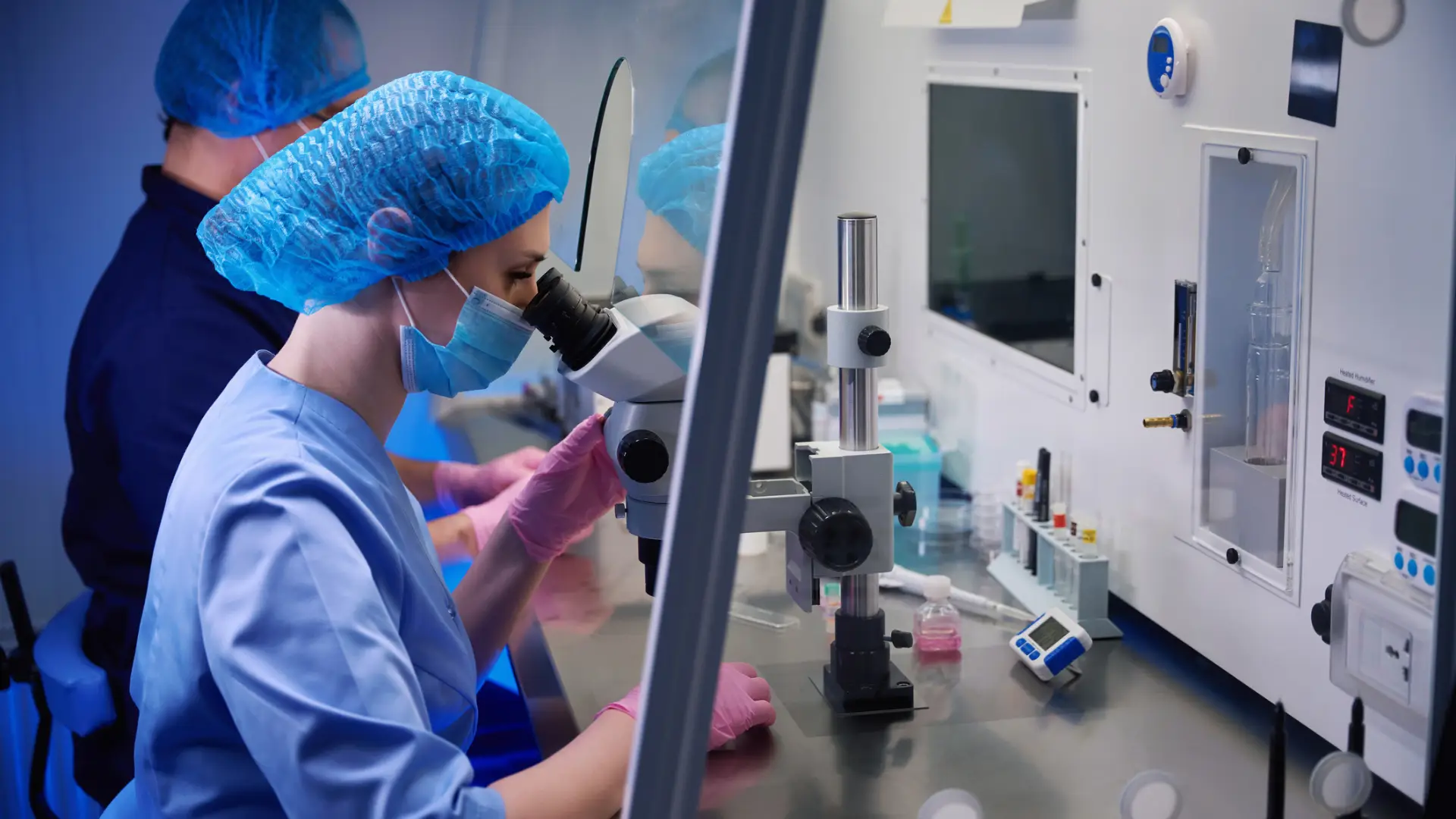
By Sara Hager, Embryologist at Illume Fertility
This article was adapted from a comprehensive guide originally published by Illume Fertility.
Starting fertility treatment means placing an enormous amount of trust in a team of medical professionals. You are trusting them with your health, your hopes for the future, and, in many cases, eggs, sperm, or embryos that cannot be replaced.
For LGBTQ+ intended parents, the process often involves additional people and decisions. Your path might include donor eggs or sperm, reciprocal IVF, embryo testing, long-term cryostorage, or a gestational carrier. It is understandable to have lots of questions about how everything is identified, protected, evaluated, and stored throughout that process.
Artificial intelligence, robotics, and digital laboratory systems can add valuable safeguards and give fertility professionals more consistent information. They can help reduce the risk of identification errors, improve specimen tracking, and support certain clinical assessments. What they cannot do is replace the judgment, experience, and compassion of the real people providing your care.
Here is an overview of what these technologies currently do, where their limitations lie, and what intended parents should ask before beginning treatment.
Protecting Eggs, Sperm & Embryos in the IVF Lab
Every egg, sperm sample, and embryo must be correctly identified throughout fertilization, embryo development, genetic testing, freezing, storage, and transfer. Electronic witnessing systems provide another layer of protection during these critical steps.
At Illume Fertility, RI Witness uses radio-frequency identification technology to assign a unique digital identity to each dish and tube containing reproductive material. Sensors confirm that the patient and specimen information match before laboratory work continues. If the system detects a potential mismatch, it immediately alerts the embryologist. The procedure must stop until the information has been reviewed and verified.
RI Witness does not replace established laboratory procedures or human witnessing requirements. It works alongside them, while experienced embryologists oversee each step and make all final decisions.
In a study of 408 IVF patients, more than 97% reported feeling highly comfortable receiving care at a clinic using an electronic witnessing system. Additional research has examined how these systems may improve traceability, reduce opportunities for identification errors, and increase confidence among laboratory professionals.
Improving Cryostorage Safety
Eggs, sperm, and embryos may remain frozen for months or years. Intended parents deserve to understand how those specimens are identified, monitored, and protected during storage.
The TMRW cryostorage platform combines digital identification, RFID tracking, automated storage, and continuous monitoring. Each specimen is connected to a documented digital chain of custody that records where it is stored and how it has been handled.
The platform also continuously monitors temperature and other environmental conditions, with expert oversight and backup systems in place.
For intended parents using donated reproductive material or working with a gestational carrier, clear documentation is especially important. A single family-building journey may involve eggs, sperm, and embryos connected to several people. Digital tracking can help laboratory teams maintain accurate records throughout that process.
Supporting More Consistent Treatment Monitoring
The person undergoing ovarian stimulation will typically attend several monitoring appointments during an IVF cycle. Depending on the family-building pathway, this may be an intended parent or an egg donor.
During these appointments, the care team uses ultrasound and bloodwork to evaluate how the ovaries are responding to medication. Follicles are counted and measured to help determine whether medication should be adjusted and when the egg retrieval should occur.
Cycle Clarity uses AI-assisted imaging to help identify, count, and measure follicles during an ultrasound. It can provide more standardized measurements and may shorten the time required to complete each scan.
This technology does not determine medication doses or treatment timing. Physicians and clinical team members review the information alongside hormone levels, medical history, and the patient’s individual response before making any decisions.
Can AI Choose the Best Embryo?
After fertilization, embryologists monitor how embryos develop and evaluate which one(s) have the strongest potential to result in pregnancy. Traditionally, this has involved examining each embryo under a microscope and assigning a grade based on its appearance and stage of development.
AI tools can analyze embryo images and identify patterns that may be difficult to detect through visual assessment alone. They may also help make evaluations more consistent and reduce the amount of time embryologists spend reviewing images.
However, current evidence does not support allowing AI to select embryos independently.
- A 2024 randomized trial published in Nature Medicine compared AI-based embryo selection with standard assessment by trained embryologists. The trial did not demonstrate that AI performed as well as traditional morphology-based selection according to the study’s predetermined criteria.
- A related Nature Medicine analysis cautioned that expectations for AI-assisted embryo selection have often moved faster than the supporting evidence.
- The American Society for Reproductive Medicine (ASRM) describes AI as a potentially valuable supporting tool but emphasizes the need for further clinical validation and well-designed randomized trials.
AI can offer embryologists another useful source of information. It should never replace their expertise or make the final decision about which embryo to transfer.
AI & Genetic Testing
Some laboratories are also exploring machine learning as part of preimplantation genetic testing (PGT).
PGT involves taking a small sample of cells from an embryo and analyzing them for chromosomal abnormalities, specific inherited conditions, or structural chromosome changes. Certain testing platforms may use machine learning to compare results with large datasets and assist with interpretation.
Because these results can affect which embryos are considered for transfer, patients should understand which laboratory is performing the testing, how results are reviewed, and whether a genetic counselor will be available to explain them. At Illume, our in-house genetic counseling team provides comprehensive support for families with genetic concerns and those pursuing genetic carrier testing or PGT.
The bottom line: technology may help analyze complex data, but qualified laboratory professionals, physicians, and genetic counselors must still interpret that information within the context of each patient’s circumstances.
Why Human Expertise Still Matters
Technology can identify patterns, organize information, and automate certain safety checks, but it cannot understand everything that shapes a family-building decision.
LGBTQ+ intended parents may need to consider donor selection, reciprocal IVF, genetic testing, surrogacy, treatment timing, financial resources, and how each parent hopes to participate in the process. These decisions involve personal values, relationships, medical realities, and emotional readiness.
An algorithm cannot fully understand those factors. It also cannot listen to your concerns, explain uncertainty with compassion, or recognize when the original treatment plan no longer feels right for your family. The strongest approach combines proven technologies with an experienced, affirming care team that understands both the medical process and the many different ways families are built.
Questions to Ask Your Fertility Clinic
- How are eggs, sperm, and embryos identified and tracked?
- What technology is used to monitor frozen specimens?
- Does AI play a role in treatment monitoring, embryo assessment, or genetic testing?
- Who reviews the technology’s findings?
- Who makes the final treatment decisions?
- Has the technology demonstrated a meaningful benefit for patients?
- Is it included in standard care or offered as a paid add-on?
- How is patient information stored, protected, and used?
Any fertility clinic should be able to explain what technology it uses, why they use it, what the evidence shows, and where the technology’s limitations lie.
Technology Should Strengthen Care
New technology can make parts of fertility treatment safer, more consistent, and more efficient.
It can add safeguards inside the IVF laboratory, strengthen specimen tracking, and give care teams more information to consider. But newer does not automatically mean better. Every tool should be evaluated based on its safety, accuracy, evidence, and actual benefit to patients.
Most importantly, technology should support the team who is caring for you, not come between you and them. Fertility treatment is deeply personal, and intended parents deserve both advanced medical care and a team that recognizes the real, human impact of every decision.
This article is for informational purposes only and does not constitute medical advice. Please discuss your individual circumstances and treatment options with a qualified fertility specialist.
About the Author
Sara Hager is an embryologist with four years of experience working in the IVF laboratory at Illume Fertility. Her work supports critical stages of in vitro fertilization, including embryo development and laboratory procedures that promote quality and consistency of care. Sara holds a Bachelor of Science in Biomedical Sciences and is currently pursuing a master’s degree in reproductive science.