During our stint in L.A., we had a tiered system to determine the extent of physical contact with Leila, not unlike Australia’s koala experience. Entry-level ticketholders got a side-by-side pose. Premium visitors could touch her. VIPs got a proper hold.
Who got to assign the tier, however, was not always clear. My original instinct was to let any close friend hold our little koala as long as they washed their hands and appeared competent. After all, those were the two dangers: germs and dropping her. I’m a people-pleaser to a fault and felt that holding Leila was the expected reward for coming to visit.
But Mom, in a wise motherly tone, convinced us to switch to an opt-in system. “Not all of your friends need to hold her. Or want to hold her. It’s a different story if someone asks.”
Well, many someones asked. I could tell it was coming from the way they washed their hands. These people didn’t do the quick lather of someone planning to squeeze Leila’s foot; they rinsed like a chef who’d just handled raw chicken. “Okay, I’m ready,” they’d say as they returned the hand towel to its perch. The hardcore ones rebuffed our offer to lay a swaddle over their clothes. “I don’t care about spit-up,” they scoffed, with an implied, “STOP STALLING AND GIMME BABY!”
Our House Rules, in summary, stipulated that all visitors must wash their hands and that visitors who asked to hold Leila could do so.
You can imagine my surprise, then, when Mom passed Leila into the arms of friends who did not ask to hold her. The hypocrisy!
“But Margaret has known you since YOU were a baby,” she replied in defense.
“Ellen drove all the way from San Diego.”
“Lisa bought her the most adorable outfit.”
So, naturally, I devised my own justifications, and soon our rules took a backseat to watching friends light up at the sight of our darling girl.
Which was wonderful. Most of the time.
I’ll never forget when one person said, “Congrats, Charlie! You got a baby!” Maybe I’m thin-skinned with this stuff but got? We didn’t buy her on Amazon.
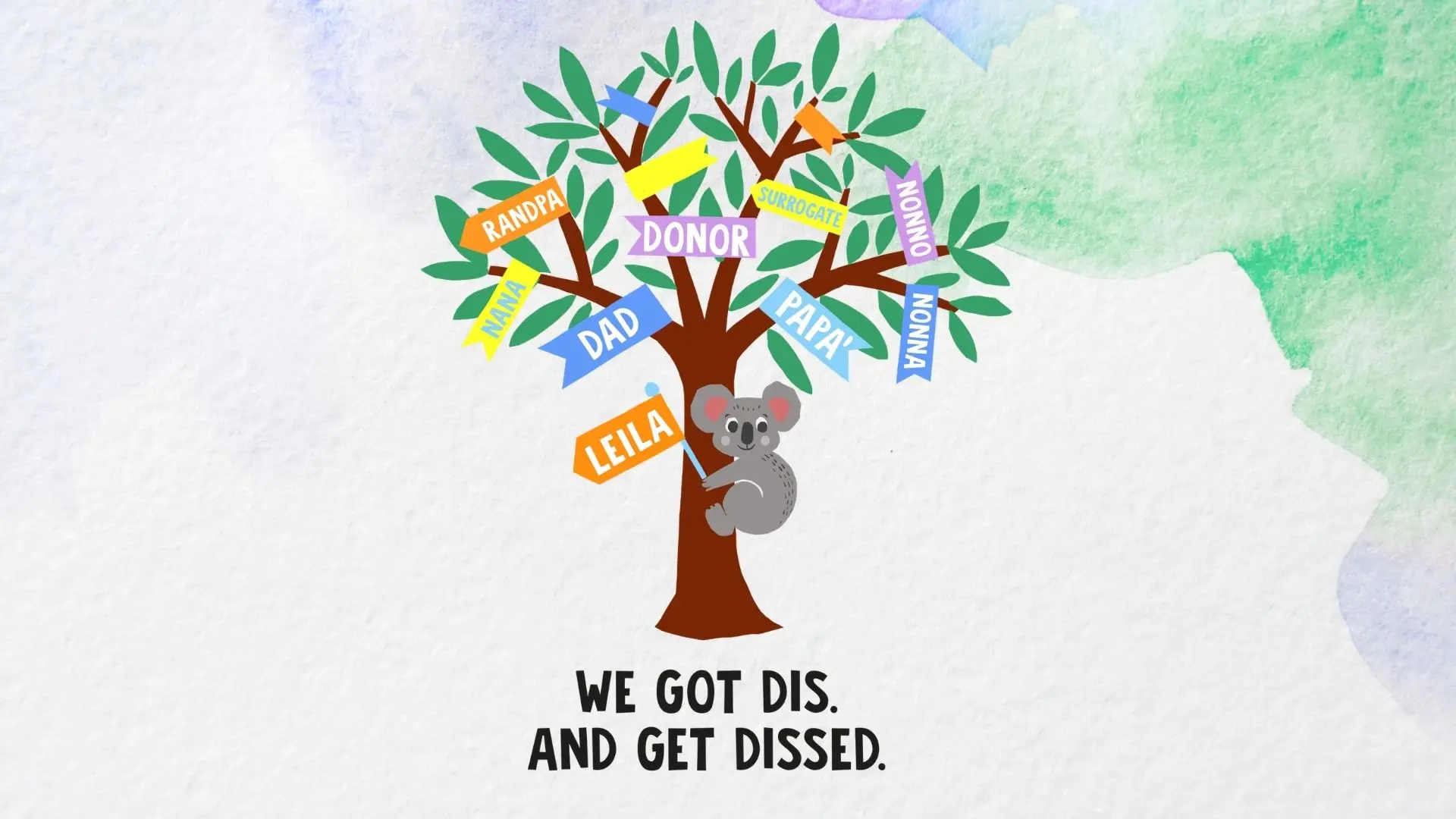
“Does she look like the mother?” others asked, failing to realize we preferred the terms donor and surrogate/carrier, words that denote a finite role instead of an ongoing relationship. Asking about Leila’s mother added an emotional element to an arrangement I viewed as mechanical. It highlighted what we as a family were missing.
But many people instinctively said “mother,” and though I’d like to think I have exceptional EQ, I wouldn’t have known better either prior to our journey. It’s not obvious if you haven’t been through it. It’s a lack of exposure, I reminded myself, not a lack of consideration. It’s a fast-changing world for everyone, and how cool that I could be the first gay dad of a surrogacy-born child to teach others how to treat us.
Half of the time, these questions were in the present tense: “Who is the mother?”
The other half of the time, questions followed this pattern: “Who was the mother?” Then, after hearing “was” out loud, the person quickly followed up with, “Wait, no, that sounds like the mother died. Who is the mother? You know what I mean.”
I did.
I also knew what people meant when they asked, “So Leila is yours, Charlie?” Or a variation like, “Who’s the father?” “Will Paolo have a baby next?”
Beyond our circle of friends, comments were more egregious. I have a theory that strangers feel more comfortable approaching a man with a baby than a woman with a baby. This applies to both genders. Male strangers think it’s less predatory striking up conversation with me than with a new mom, where friendliness might be misconstrued as flirtation. And female strangers aren’t concerned that probing will come across as critical or competitive in the same way it might when moms talk to each other.
Exhibit A: A random lady in the park asked Paolo and me, as her opening line, “How old was she when you picked her up?”
Exhibit B: The three of us were out to dinner and the waiter, after learning that Paolo and I were the fathers, said to me, “I was about to say she looks like you but that’s impossible.”
Exhibit C: A store attendant asked if we celebrate Mother’s Day. It took me a second to register her meaning. “Yes,” I replied. “For our own mothers. But we celebrate Father’s Day with Leila since we are her fathers.”
I never accused anyone of malice in such cases. Ignorance, yes. And stupidity. But not a conscious intent to make us feel inferior. I either bit my tongue or responded gently in an effort to educate, with the exception of one instance that left me stunned.
An acquaintance, Daniel, invited us to his housewarming party. With Leila in a carrier on my chest, we let ourselves in and found him in a group of people we didn’t know. We answered expected questions like, “What’s her name?” “How old is she?” etc. Then Daniel asked, “Do you know the parents?”
My mind raced to reply as I processed an ambush of emotions that included surprise, anger, sadness, and embarrassment. Four months into same-sex parenting, I was accustomed to a wide range of personal and potentially invasive questions, but nothing had knocked the wind out of me like this.
First, he assumed we adopted. Something about that mistake, in general, peeves me. It’s hard to put a finger on. It’s partly my ego. Paolo and I worked hard to navigate the surrogacy landscape, and a quick assumption like that undermines our efforts. That’s not to say parents of adopted kids don’t work hard to navigate that process, too. Of course they do.
I’d feel the same in the inverse scenario: if we’d adopted and someone assumed we used a surrogate.
Having to correct someone is inherently more tense than answering an open-ended question.
I’m also sensitive to the idea that adoption is a more noble path for gay men, as I touched on before. Daniel probably assumed we adopted because he approved of us adopting. It’s a mental model with appealing symmetry: a kid in search of parents + parents in search of a kid. And just like the adoption questions we received prior to having kids, his question called attention to the counterfactual. Whenever I’ve had to say, “No, we didn’t adopt,” a guilt-ridden voice inside of me twists our valid decision into a shameful admission: “No, we didn’t choose to provide a better life for someone else’s baby.”
But above all else, Daniel’s precise words—“Do you know the parents?”—hit a nerve because they discredited our role as Leila’s legitimate parents.
I couldn’t hide my disdain. “We are the parents, so yes, we know them well.”